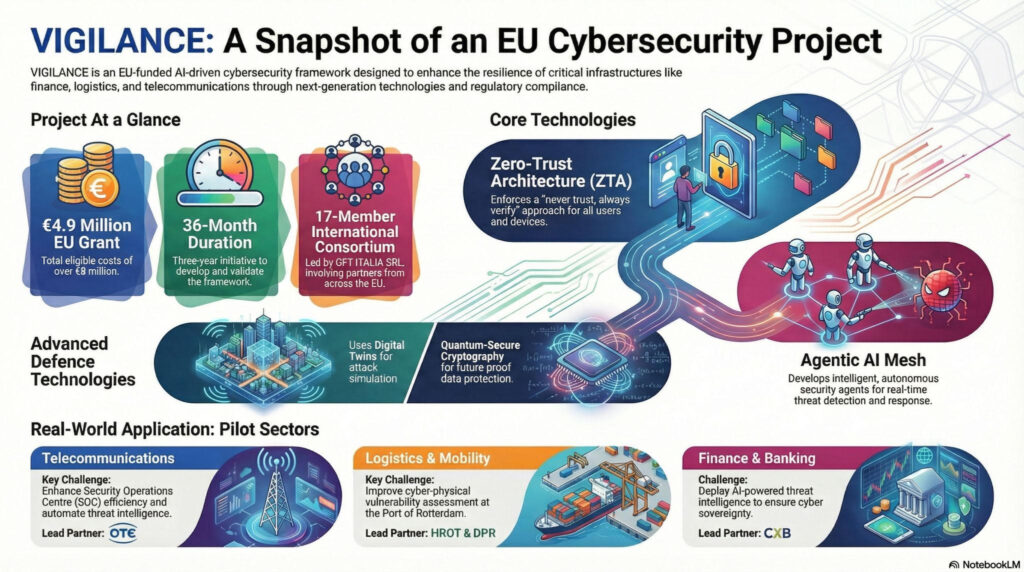

UBITECH announces its participation in the newly launched European research project VIGILANCE – Versatile Intelligent aGents for Interconnected Ledgers and Autonomous Next-gen Cybersecurity Ecosystems (Grant Agreement No. 101249737). The project officially kicked off with a two-day meeting hosted by OTE on 12–13 January 2026 in Athens, Greece. VIGILANCE is a 36-month research and innovation action running from January 2026 to December 2028 and is coordinated by GFT. The project brings together a strong European consortium with the shared ambition of transforming the cybersecurity landscape for Critical Infrastructures, public-sector organisations, and private enterprises. The primary goal of VIGILANCE is to lower the effort and cost required by cybersecurity vendors and Critical Infrastructure operators to establish, deploy, and operate intelligent cyber-defence strategies based on Zero Trust Architecture principles.
To achieve this, the project will deliver a highly innovative, scalable, incremental, and operational five-layer platform characterised by a high degree of autonomy and scalability. By leveraging advances in Adversarial Artificial Intelligence, Generative AI, Blockchain technologies, and Quantum Computing, VIGILANCE aims to strengthen continuous verification mechanisms, enable real-time anomaly detection, and support adaptive risk and vulnerability assessment. These innovations will drive a fundamental shift from today’s largely reactive cybersecurity approaches towards a proactive, self-sustaining, and scalable security ecosystem.
Within VIGILANCE, UBITECH plays a central role by leading the development of advanced cybersecurity solutions. The company is responsible for driving adversarial simulations, penetration testing, and Red Teaming frameworks that rely on AI-driven attack simulations to rigorously assess the security posture of critical infrastructures, small and medium-sized enterprises, and public-sector organisations. The proposed framework will simulate realistic attack scenarios by emulating advanced persistent threats, cybercriminal behaviour, and nation-state-level adversaries, enabling the identification of vulnerabilities, system misconfigurations, and security gaps that are often overlooked by conventional vulnerability assessment methodologies.
UBITECH’s work in VIGILANCE further integrates game-theory-based decision-making models, AI-assisted attack simulation engines, and automated risk assessment tools to deliver comprehensive and continuous security testing. Particular emphasis is placed on the generation of adversarial data targeting Generative AI systems, with a focus on addressing the top threats affecting large language models as identified by OWASP, including prompt injection, insecure output handling, and training data poisoning.
In parallel, UBITECH is also leading activities related to Quantum Security for Data Sharing and Transfer Services within the project. These efforts focus on the integration of homomorphic encryption, quantum-resistant encryption schemes, Quantum Key Distribution, and hybrid encryption techniques. The objective is to ensure confidential, resilient, and scalable data exchanges between government agencies, critical infrastructure operators, and private-sector partners, even in the face of emerging quantum-era threats.
All technical contributions from UBITECH are carried out by the company’s Secure Systems & Trusted Computing Research Group. Dr Thanassis Giannetsos, Head of Secure Systems & Trusted Computing, stated “With VIGILANCE, we are working towards a new generation of cybersecurity that is intelligent, automated, and built to scale. At UBITECH, our focus is on using AI-driven attack simulations and advanced Red Teaming to realistically test how systems behave under real-world cyber threats. This allows us to identify weaknesses that traditional security assessments often miss. In parallel, we are integrating quantum-resilient and privacy-preserving technologies to secure data sharing in highly sensitive environments. Through VIGILANCE, we aim to help organisations move from reactive security practices to proactive, self-adapting cyber-defence ecosystems that can keep pace with rapidly evolving threats.”