
UBITECH’s Secure Systems and Trusted Computing Research Group brought European post-quantum cryptography research to Tokyo this month, representing the Digital Europe-funded PiQASO project at the Trusted Computing Group (TCG) Japan Regional Forum (JRF) Workshop, held 10–13 February 2026. Dr. Thanassis Giannetsos, Head of the Secure Systems and Trusted Computing Research Group at UBITECH and Technical Coordinator of PiQASO, attended alongside Stefanos Vasileiadis, Tech Leader for Trusted Computing within the same group. The pair engaged directly with an international community of standards bodies, hardware vendors, and government representatives shaping the next generation of trusted computing infrastructure.
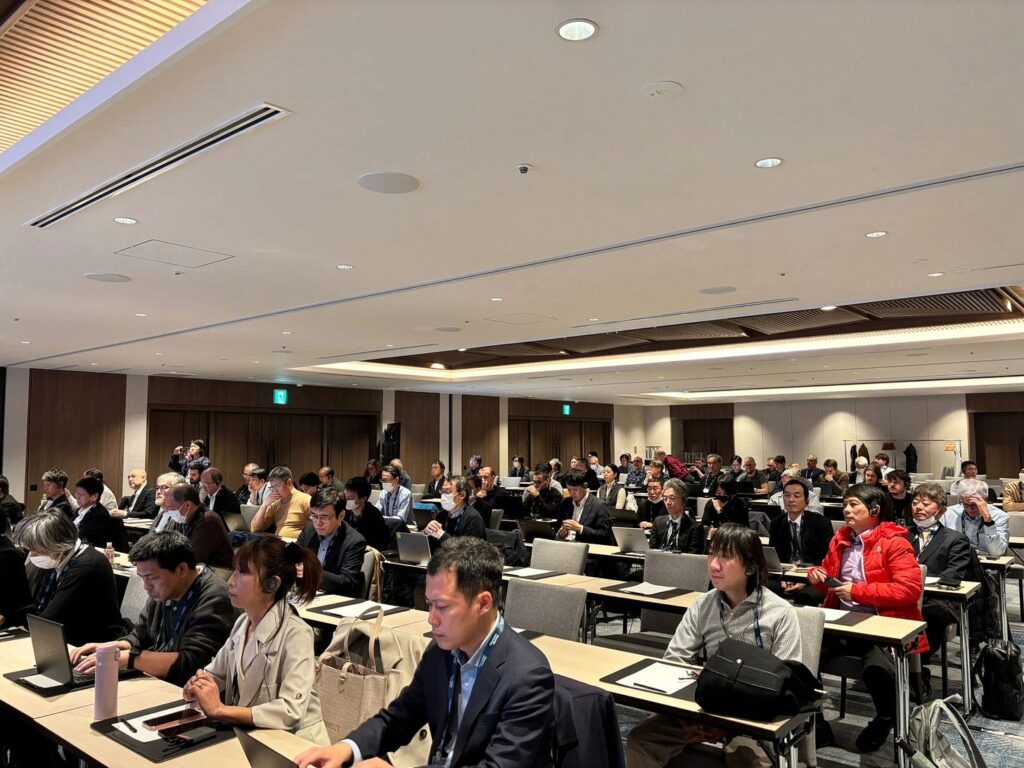
The TCG JRF Workshop is a leading annual gathering that brings together industry, government, and technical experts to advance trusted computing standards. This year’s programme centered on two themes of direct relevance to PiQASO’s mission: the standardisation of security technologies compatible with post-quantum cryptography and artificial intelligence, and industry and government readiness for the EU Cyber Resilience Act, due for implementation in 2027. Sessions spanned PQC composite signatures and key encapsulation mechanisms, secure supply chain attestation, and trust mechanisms for AI environments, with contributions from organisations including Google, HP Labs, NVIDIA, and Japan’s Ministry of Internal Affairs and Communications.
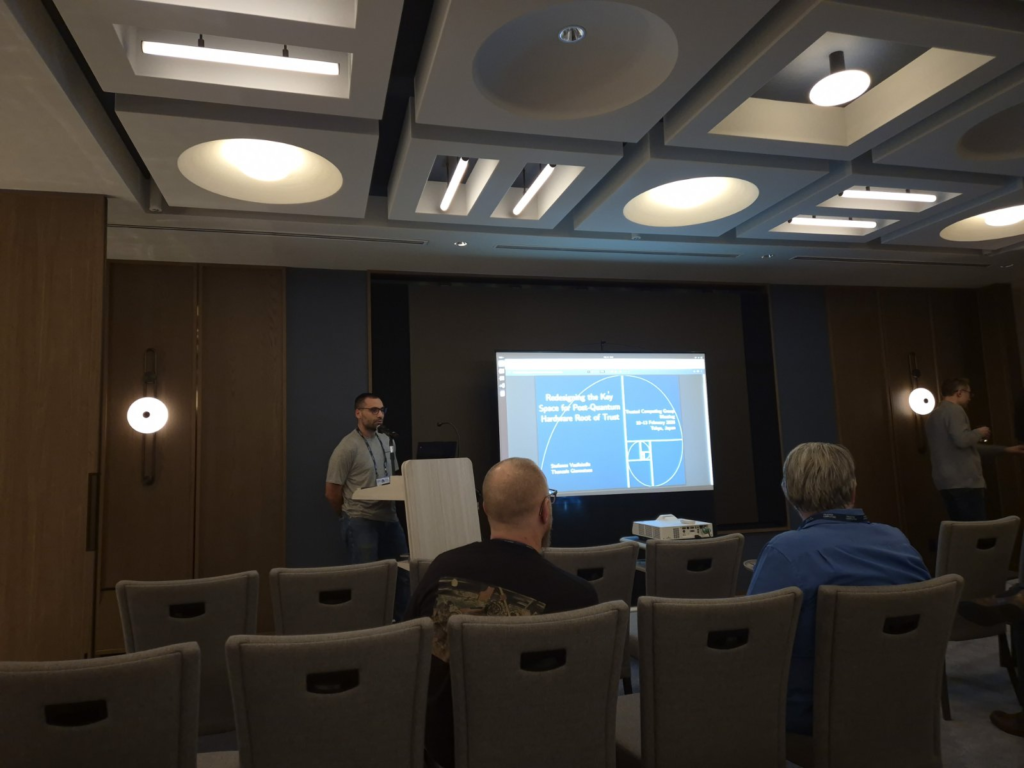
As part of the technical programme, Vasileiadis and Giannetsos delivered a presentation titled “Redesigning the Key Space for Post-Quantum Hardware Root of Trust,” examining how the structure of lattice-based key spaces underpinning standards such as ML-KEM, ML-DSA, and FN-DSA can be reengineered to ease the practical burden these schemes place on constrained hardware. The talk set out the core hash-sign-verify workflow underlying hardware root of trust attestation, detailed the Short Integer Solution problem that governs the hardness of lattice signatures, and introduced a new construction, OSLS-128, that reshapes the secret key geometry and gadget structure at the heart of these schemes. Benchmarked against ML-DSA-2 (Dilithium) and FN-DSA-512 (Falcon) at NIST Level 1 security, the proposed approach was shown to reduce secret key storage to 32 bytes, a roughly seventy-nine-fold improvement, while producing signatures under one kilobyte, within the buffer constraints of a Trusted Platform Module, and replacing complex NTT and FFT arithmetic with simple integer operations suited to low-power secure boot and vehicle domain applications.
Dr. Giannetsos’s participation extended beyond the technical presentation. He took part in high-level sessions addressing the future of trusted computing standards and the protection of infrastructure against emerging quantum threats, with his contributions centering on three areas: the standardisation of post-quantum cryptography and its integration with artificial intelligence, the assessment of industry readiness for the 2027 EU Cyber Resilience Act, and the shaping of advanced hardware security mechanisms, including composite signatures and secure supply chain attestation.
“Trusted computing standards are being rewritten in real time as the industry prepares for the post-quantum transition, and it was important for European research to have a voice in that conversation,” said Dr. Thanassis Giannetsos, Head of Secure Systems and Trusted Computing Research Group at UBITECH and Technical Coordinator of PiQASO. “The work we presented in Tokyo shows that post-quantum hardware roots of trust do not have to come at the cost of silicon area or memory footprint. Engaging directly with organisations like TCG, Google, HP Labs, and NVIDIA, alongside government stakeholders preparing for the Cyber Resilience Act, gives us the clearest possible picture of where standards are heading and ensures PiQASO’s research remains aligned with, and relevant to, that trajectory.”
PiQASO’s presence at the TCG JRF Workshop reflects the project’s ongoing commitment to engaging with international standardisation bodies and tracking global developments in post-quantum cryptography, an area central to its objectives. By contributing original research on lattice key space design directly to this standards-setting community, UBITECH continues to position European post-quantum research at the center of the global transition toward quantum-resistant trusted computing infrastructure.
More information on the TCG Japan Regional Forum Workshop is available at trustedcomputinggroup.org
More information of the PIQASO Digital Europe action is available at https://www.piqasoproject.eu/